




News

- Address: 江苏省苏州市苏州工业园区若水路398号
- E-mail: tzhang2009@sinano.ac.cn
- TEL: 86-512-62872706
- FAX: 0512-62603079
- Website: http://nanosensor.sinano.ac.cn

Congratulations to our group's Master student, Yuchen Zhou, and associate professor, Lianhui Li, for their paper "Flexible Hydrovoltaic Devices With Controllable Ion-Sensitive Windows for Trace-Ion Variation Sensing" being published in journal Advanced Functional Materials
ABSTRACT
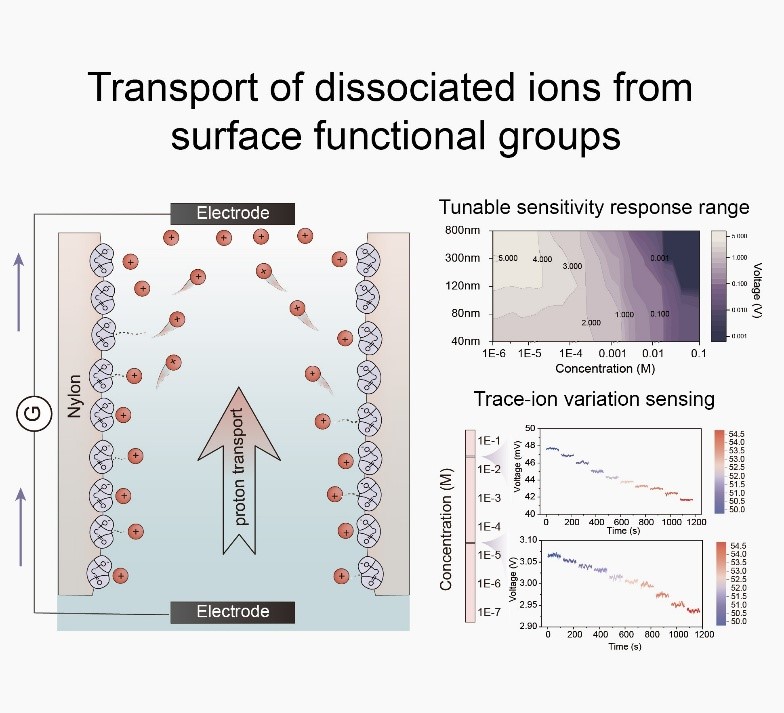
Evaporation-driven hydrovoltaics offer substantial potential for environmental energy harvesting and self-powered ion sensing, where probing into the ion origin of electric signals at the solid-liquid interface is a critical fundamental undertaking that requires sustained advancement for highly controllable hydrovoltaic device construction. Here, we demonstrate the ion-to-electric signal conversion mechanism in hydrovoltaic systems and leverage it toward the construction of flexible hydrovoltaic devices with controllable ion-sensitive windows for trace-ion variation sensing against high backgrounds. Compared to trace ions in bulk water, ions dissociated from carboxyl group-rich nanochannel surface account for most of the voltage signal contribution, establishing the dominant role of surface-dissociated protons in electricity generation. Hydrodynamically, ion transport efficiency exhibits threshold behavior constrained by flow resistance and near-surface velocity decay induced by the size effect. Building upon the resulting mechanism, we constructed flexible hydrovoltaic devices with tunable optimal ion-sensitive concentration ranges from 1 × 10⁻⁶ m to 1 × 10⁻¹ m by controllable nanochannel design, enabling the sensitive detection of minute (1%) ionic concentration variations under high-background concentrations over 50 mm for NaCl solutions. This work provides a theoretical and technical foundation for the highly controllable construction of hydrovoltaic devices driven by evaporation.
URL: https://advanced.onlinelibrary.wiley.com/doi/10.1002/adfm.202508734