
文章专利

- 地址: 江苏省苏州市苏州工业园区若水路398号
- 邮箱: tzhang2009@sinano.ac.cn
- 电话: 86-512-62872706
- 传真: 0512-62603079
- 网址: http://nanosensor.sinano.ac.cn

A Symbiotic Skin Hydrogel Interface Enabled by Flexible Hydrogel Network with Embedded Enhancement Structure, Nature Communications, 2026, 17(1): 8528.
Jun Ma; Mingxu Wang; Yongfeng Wang; Qian Wu; Cunkai Zhou; Yuchen Zhou; Changlei Ge; Jixiao Guo; Feijun Zhao; Mingming Hao; Chonghui Fan; Feng Wen; Shuqi Wang; Mengyuan Liu; Yujie Liu; Hao Shen; Lianhui Li*; Zhang Ting*;
Abstract
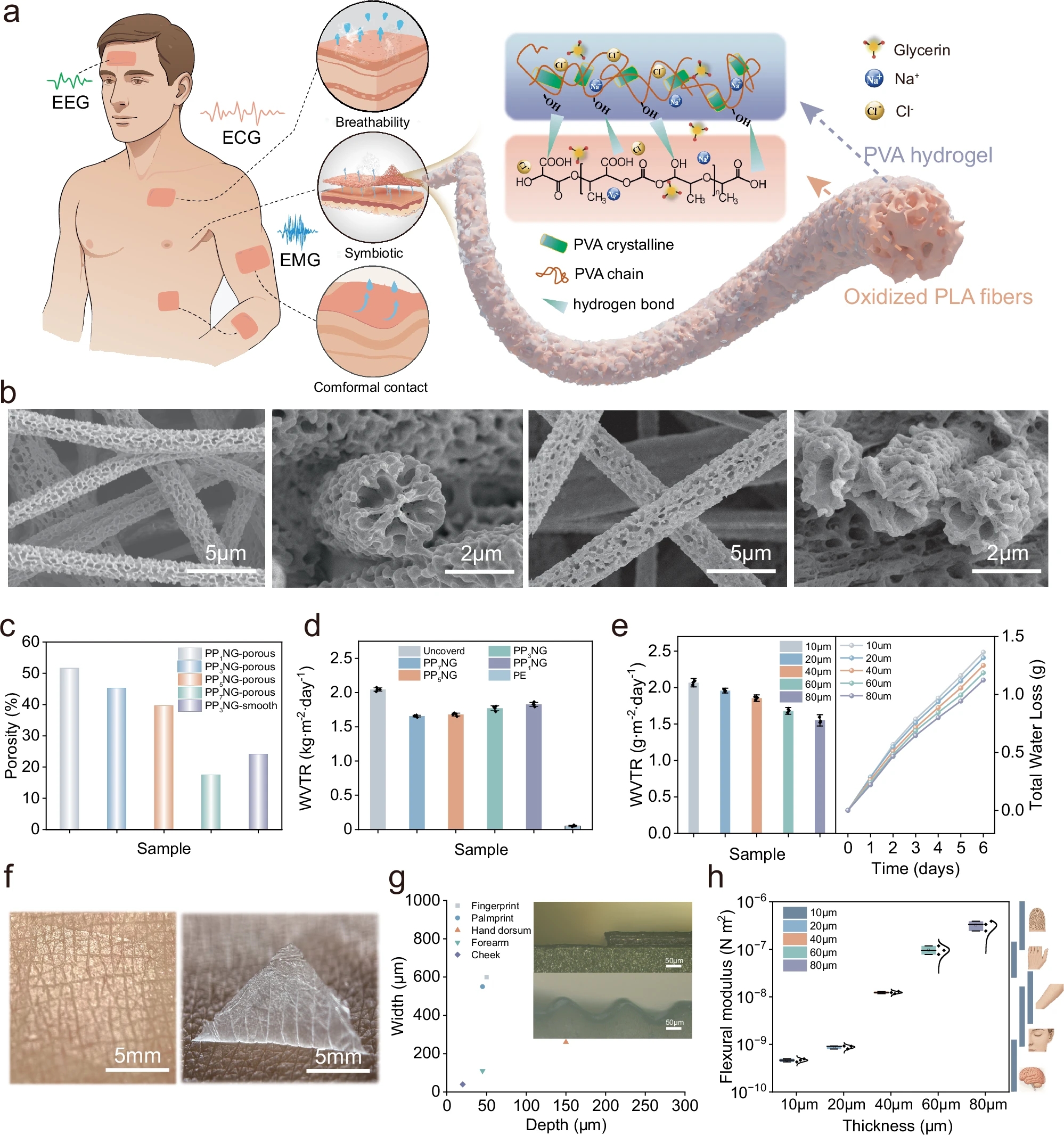
Wearable electrophysiological monitoring based on hydrogel electrodes is pivotal for decoding the body’s “electrical language”, yet fundamentally hampered by the unstable mechano-electrical interface between flexible electrodes and the skin caused by dehydration and poor breathability. Here, we demonstrate a symbiotic interface between an embedded-interfacial enhanced breathable conductive hydrogel network (BCHN) and skin for high-fidelity long-term electrophysiological monitoring. By embedding sodium chloride-containing polyvinyl alcohol hydrogel into an oxidized electrospun 3D porous polylactic acid skeleton, a BCHN with embedded enhanced interface featuring dense ion transport pathways and multiple water molecule-adsorbing sites is constructed. Upon application, the breathable (1.85 kg·m⁻²·day⁻¹, ~3× skin perspiration) flexible conductive hydrogel network with bending stiffness of ~10−10 N·m² seamlessly conforms to the microscopic landscape of the skin, forming a symbiotic BCHN-skin interface, which allows BCHN to “breathe” in harmony with the skin to preserve stable hydration and conductivity by dynamically balancing sweat capture, permeation, and evaporation, evidenced by a sustained 55 Ω impedance even at 20%RH. Integrated into a wearable monitoring system, the BCHN electrodes maintain high-quality signals (SNR > 25 dB) for over 30 days, thereby permitting the quantitative assessment and early warning of driver fatigue through long-term electroencephalography analysis.
URL: https://www.nature.com/articles/s41467-026-75372-3