
文章专利

- 地址: 江苏省苏州市苏州工业园区若水路398号
- 邮箱: tzhang2009@sinano.ac.cn
- 电话: 86-512-62872706
- 传真: 0512-62603079
- 网址: http://nanosensor.sinano.ac.cn

A Lamellarly Controlled Molecular-Redox-Driven Memristor for Pruned Spiking Neuromorphic Computing, Advanced Materials, 2026, 38(22): e12521.
Cheng Zhang#; Qinan Wang#; Chun Zhao#; Huanjun Lu; Chao Li; Kuaibing Wang; Xiaowei Wang*; Yinxiao Li; Fangchao Li; Fuqin Sun; Lin Liu; Yingyi Wang; Kejie Guan; Zhongrui Wang; Lixing Kang*; Wenhu Qian; Mengjiao Li; Yang Li*; Ting Zhang*;
ABSTRACT
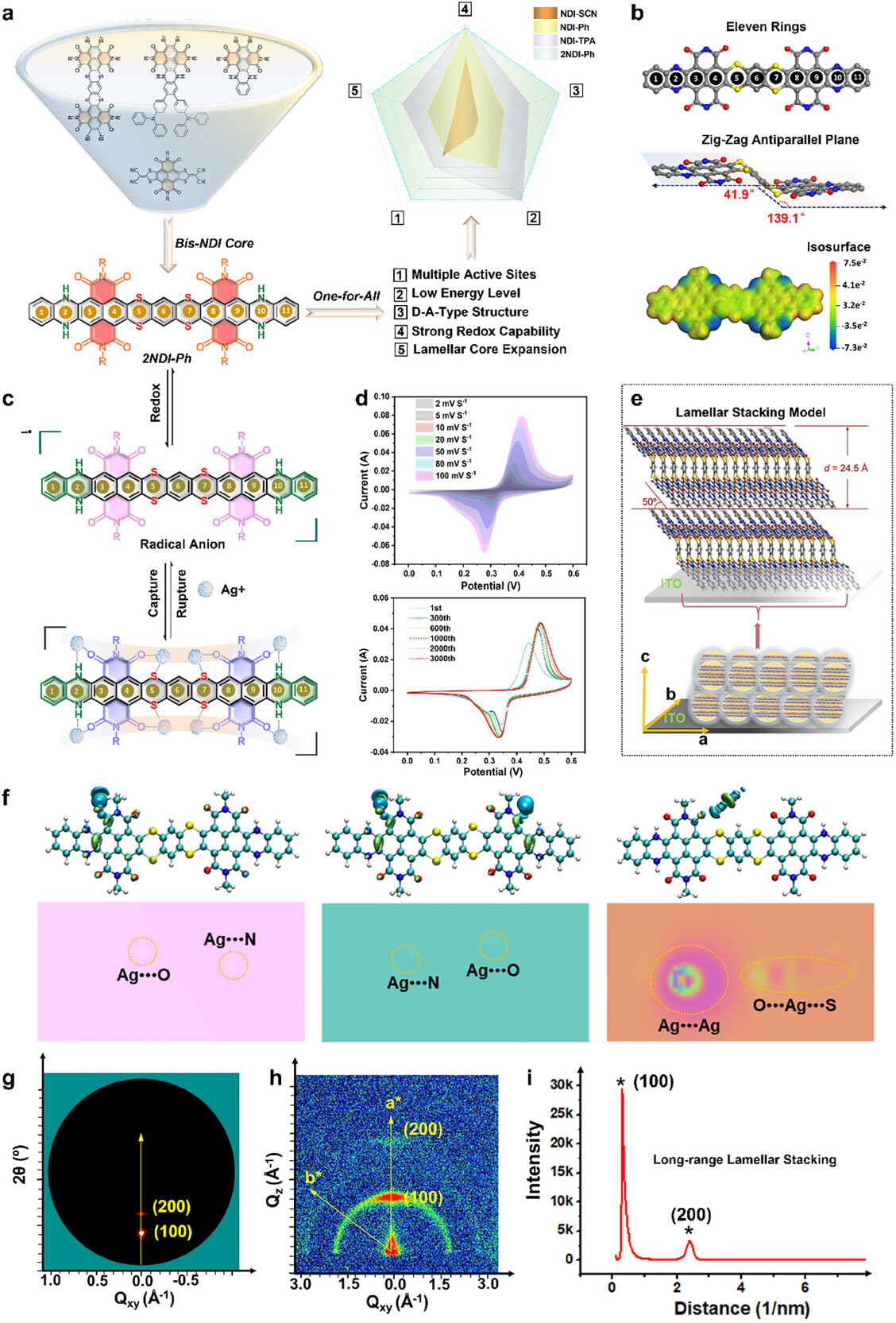
The low-power ionic-type memristor and brain-inspired neuromorphic device offer significant potential in breaking the power consumption wall. However, the precise control of uniform metallic conductive filament (CF) at both intra- and inter-molecular levels rather than random migration raises a pressing challenge. Here, we first report a symmetrical dual-core naphthalene diimide (bis-NDI) molecular material featuring multi-active and lamellarly ordered redox sites, which actuates reconfigurable analog-to-digital (A-t-D) memristive operations via the controllable manipulation of CF growth at the molecular scale. The bis-NDI-based memristor exhibits highly efficient analog synaptic behaviors, demonstrating an ultralow-power consumption of 90 aJ µm−2. By effectively re-organizing lamellar redox sites, the device dynamically implements A-t-D transition with an operating voltage of 0.5 V (lower than most reported organic memristors) and ultrahigh yield of 98%. Relying on the bis-NDI induced A-t-D dynamic plasticity, a novel feedback mechanism of pruning algorithm is subtly devised for granular error analysis and voltage adjustment validation in spiking neural networks (SNNs) computing. The co-design of material-algorithm can effectively reduce the number of connected neurons (max reduced proportion = 92%), thereby achieving ultralow systemic energy consumption while maintaining exalted recognition rates (>90%). This work paves the material-algorithm cooperation way to realize ultralow-power neuromorphic devices and highly-efficient spiking computing.
URL: https://www.webofscience.com/wos/woscc/summary/86691fca-be06-4d31-98d4-bd12a6b5d783-01cf2a79ee/relevance/1