
文章专利

- 地址: 江苏省苏州市苏州工业园区若水路398号
- 邮箱: tzhang2009@sinano.ac.cn
- 电话: 86-512-62872706
- 传真: 0512-62603079
- 网址: http://nanosensor.sinano.ac.cn

Dual-Gradient HEC-CNT/Bi2Te3 Nanowire Aerogel for Selective Flexible Sensor with High-Precision Recognition Capacity, Advanced Functional Materials, 2026, 36(47): e75562.
Shuang Xia; Yuanyuan Bai; Ju Bai1; Shen Yuan; Shengzhao Li; Ting Zhang*; Tie Li*;
ABSTRACT
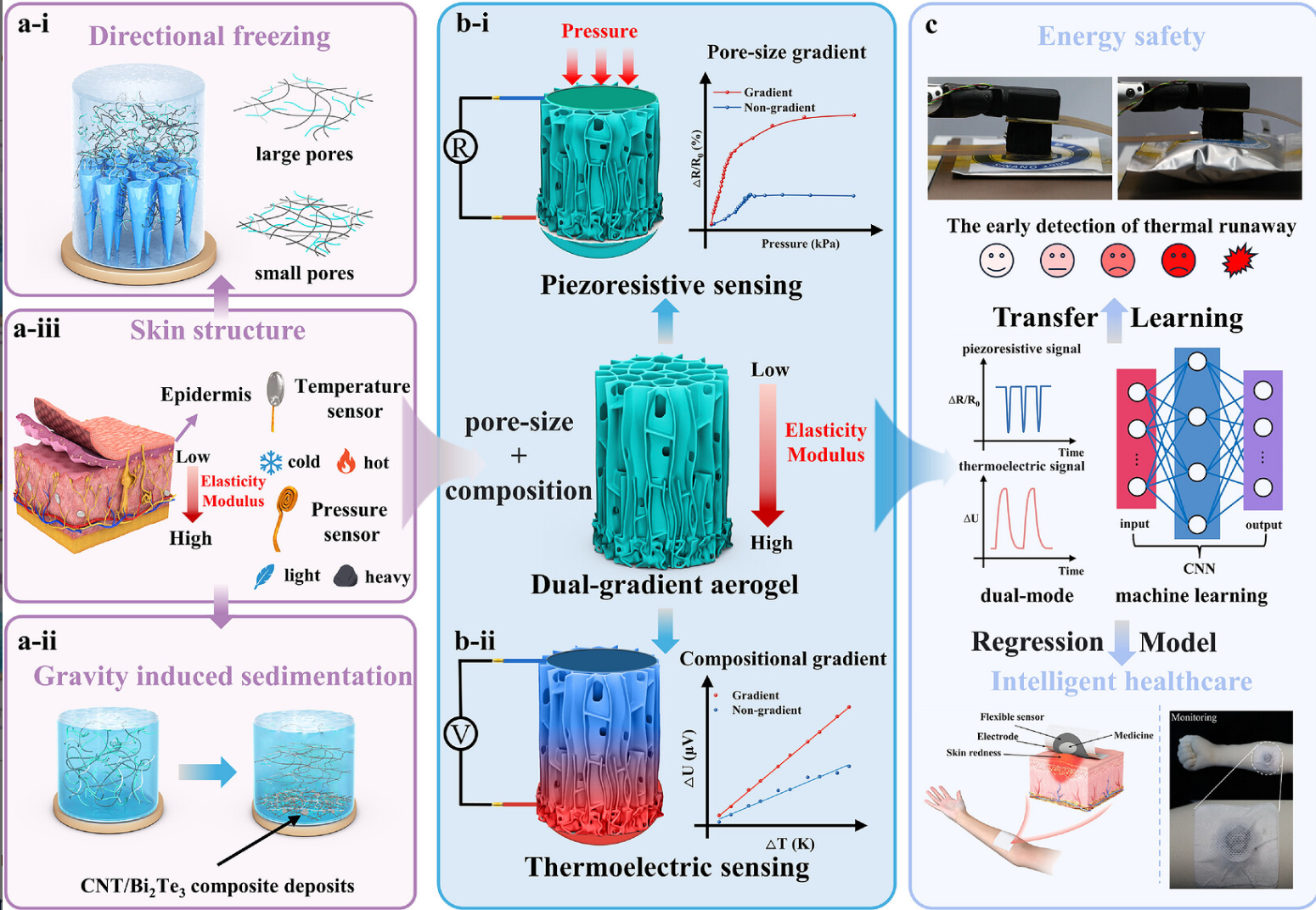
Flexible sensors that interface the physical world with digital intelligence have faced a trade-off among sensing accuracy, response selectivity, and signal decoupling. This key challenge arises from the design of high-performance sensitive materials. In this study, a dual-mode flexible sensor is assembled by a new-style dual-gradient HEC-CNT/Bi2Te3 nanowire aerogel prepared via the synchronous processes of directional freeze casting and gravity-induced self-sedimentation. This cooperative top-to-bottom pore-size and bottom-to-up compositional dual-gradient architecture enables the effective spatial partitioning of pressure and temperature sensing behaviors via generating two independent response patterns for piezoresistive and thermoelectric mechanisms, respectively. As a result, the derived device possesses the ultra-low pressure and temperature detection limit/resolution of 5 Pa/2 Pa (sensitivity of −7.97% kPa−1) and 0.1 K/0.1 K (Seebeck coefficient of −20.79 µV K−1) without any mutual interference, respectively, which is perfectly superior to that of a non-gradient device. Furtherly, this capability of the device is leveraged for robust pattern recognition and predictive analytics, achieving the ultrahigh identification accuracies of 100% and 97% for the effective warning capacities of battery thermal runaway and skin inflammation stages via using the latest convolutional neural network algorithm with transfer learning, respectively. This dual-gradient strategy establishes a feasible design paradigm for high-precision multimodal perception.
URL: https://advanced.onlinelibrary.wiley.com/doi/10.1002/adfm.75562